

Mission Statement
CRS (OECD Common Reporting Standard) and FATCA (US Foreign Account Tax Compliance Act) are global regulatory standards that compel financial institutions every year to report account data on foreign tax residents, making compliance critical for firms to avoid severe financial penalties, withholding taxes, and significant reputational damage.
Our client is a multinational, independent, privately owned firm headquartered in Jersey, providing family office services to help their growing clients manage, protect and transfer wealth across generations.
They contacted us because they were in the process of implementing a new system which has reporting capabilities but no longer wished to use outsourced service providers for their annual reporting in the interim.
However, due to the highly specific and technical reporting formats and rules required, the growing list of required data was maintained across several platforms and data sources, leading to manual collation and much back and forth, as well as adding to cost and effort from the busy teams.
Our consultants joined the team and together we were able to efficiently report the clients, hitting time and cost estimates - both reduced from previous solutions with the additional benefit of less time required from the client teams
Tools Used
Alteryx
Tax portals
Detailed Solution
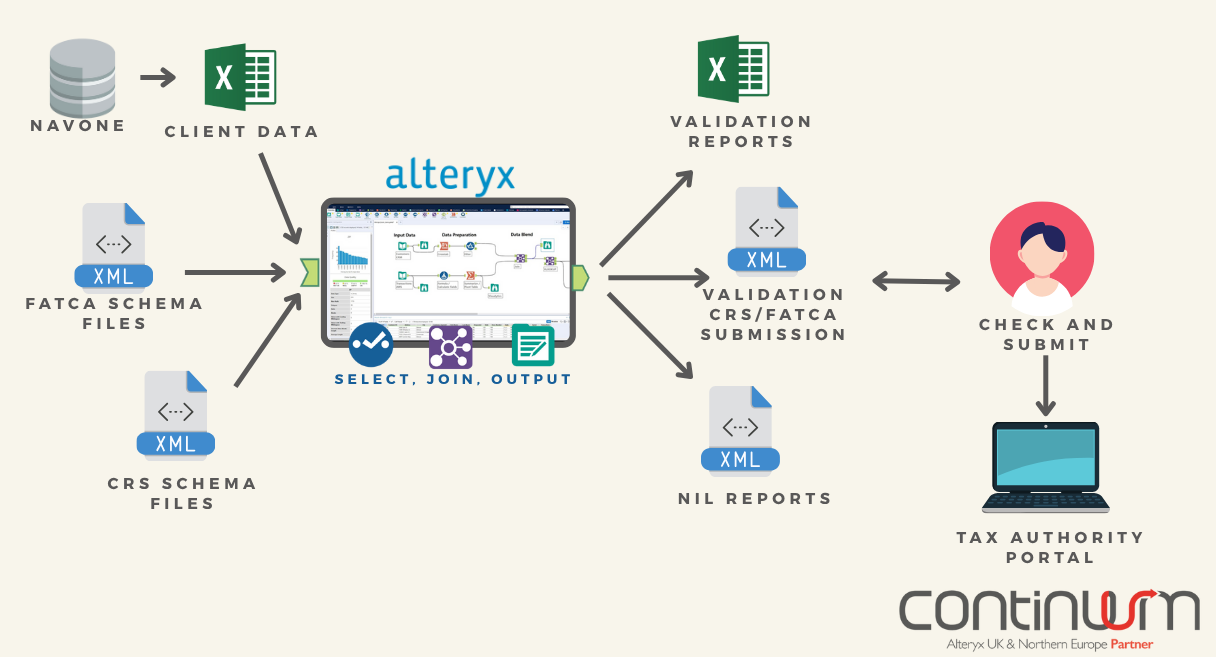
We designed and implemented a comprehensive workflow to fully automate the FATCA and CRS reporting process, addressing both operational starting points, compliance requirements and timescales.
The solution began by automatically populating template spreadsheets for review by the client teams, enabling data to be processed, validated, and corrected before submission, removing the need for time-consuming manual handling.
Following data validation, the workflow creates the CRS and FATCA files end-to-end.
All files were correctly structured and validated against the tax authorities’ XSD schema files, automatically identifying incomplete or missing data for user remediation.
To accommodate regulatory requirements, the solution included a dedicated flow for Nil Report creation and robust handling of nonstandard codes and sponsor sections, ensuring no data was overlooked.
Once processed, the system generated fully compliant XML files ready for submission to the relevant regulatory body, streamlining what was previously a complex, error-prone process.

Impact
Efficiency gains: Reduced client manual effort and turnaround time for regulatory reporting.
Accuracy and compliance: Minimised errors and ensured full adherence to regulatory standards.
Scalability: Provided a repeatable, robust process that could handle increasing reporting volumes with confidence.
User empowerment: Simplified the reporting process, giving teams clear insights into data quality and required corrections before submission.