

Guernsey CRS/FATCA reporting automation
How a Guernsey Trust Company Future-Proofed CRS/FATCA Reporting with Continuum and Alteryx
Who They Are
A leading independent provider of high-quality fiduciary, fund and advisory services, delivering solutions that help their clients grow, protect and pass on capital across generations. Their integrated service lines span Trust and Family Office Services, Funds Services, Corporate Services and Advisory Services, backed by dedicated teams across the Crown Dependencies, Switzerland, the UAE, the United Kingdom and the Cayman Islands, and clients in over thirty countries.
Like all Guernsey fiduciaries, they are a Reporting Financial Institution under the OECD's Common Reporting Standard (CRS) and US FATCA. Each year they file XML returns with the Guernsey Revenue Service covering reportable accounts across the structures they administer, including account holders, settlors, beneficiaries, protectors, shareholders, beneficial owners and other controlling persons who are tax-resident in reportable jurisdictions (for CRS) or US persons (for FATCA). Given the international nature of their client base, that reporting spans many jurisdictions and a broad mix of trust and corporate structures, making accuracy, consistency and traceability essential.
The Opportunity
Our client approached us ahead of a period of significant change for CRS and FATCA reporting, with several factors converging at once:
• Regulatory evolution: CRS 2.0 requirements come into effect for 2026 data (reporting in 2027), introducing new fields and stricter validation that they wanted to be ready for well in advance.
• Platform transition: The client are planning a migration from their long-standing NAVOne administration platform to PlainSail and wanted a reporting approach that was independent of any single underlying system.
• A move towards repeatability: like many fiduciaries, their annual CRS/FATCA cycle had grown up around expert knowledge held by a small team that was taking increasing amounts of time from valuable team members. They wanted to codify that logic into a documented, rerunnable process, better for succession, audit, and year-on-year consistency.
• Complex, high-quality structures: Our client administers layered trust and company structures with shareholders, beneficial owners, and controlling persons that all need to be treated consistently in reporting. Getting the selection logic exactly right across several hundred records is meticulous work that lends itself well to automation.
Rather than wait for the platform migration or the new regime to arrive, our client chose to get ahead of both, building a rerunnable, auditable reporting process that would serve them through the transition and beyond.
How We Helped
Continuum ran a focused, evidence-led pilot rather than jumping straight to a fixed-scope build:
• Discovery first: an onsite workshop and database discovery sessions in Guernsey to understand the NAV1 data model, existing tax-tracker logic, and how the 2024 submission was produced, building on the knowledge of team rather than replacing it.
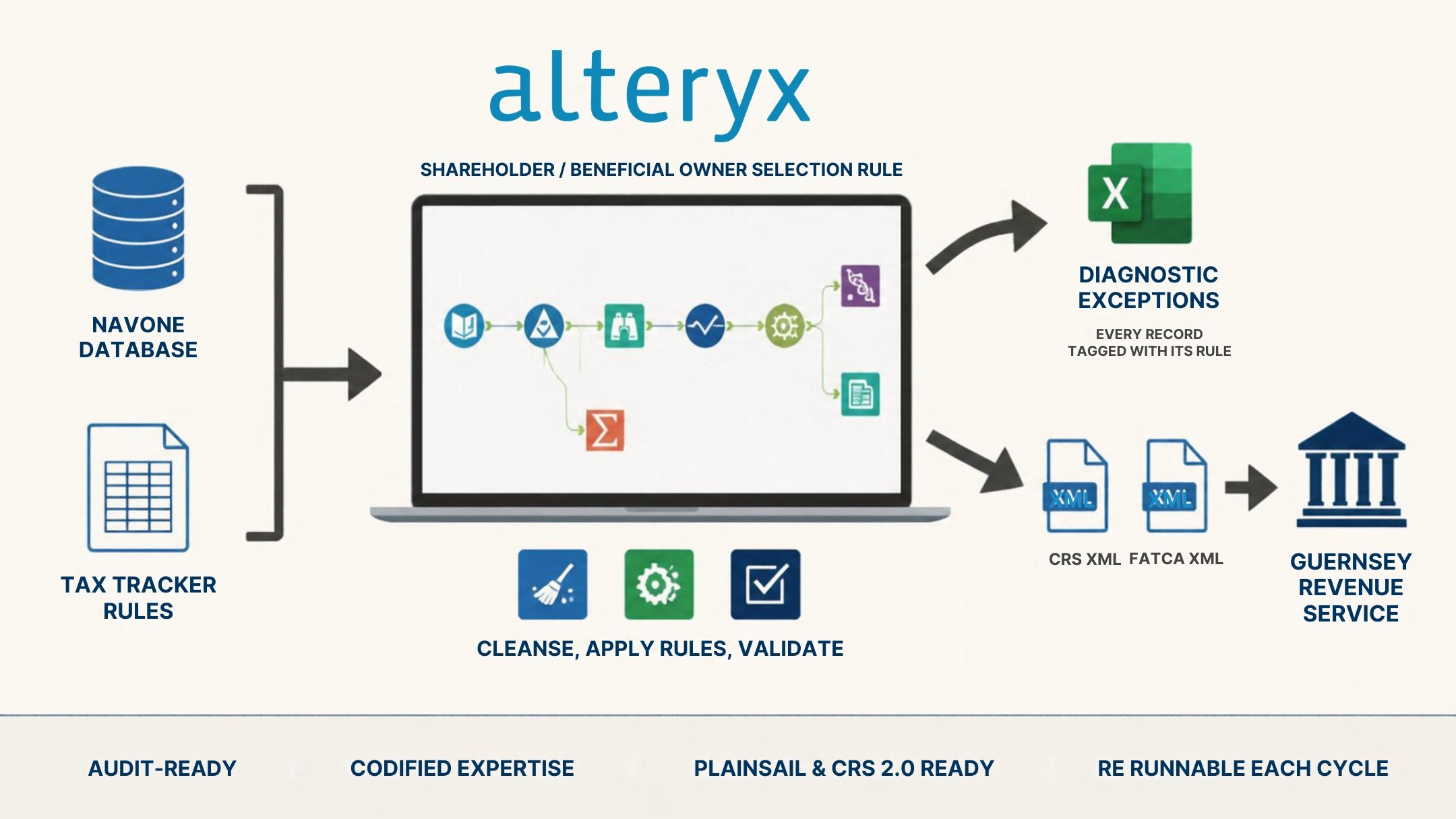
• An Alteryx-built reporting engine: a workflow connecting directly to the client’s database that produces both diagnostic spreadsheets, every record tagged with the exact rule that included or excluded it, and validated CRS and FATCA XML output for individuals and organisations.
• Rules refined together, weekly: through iterative review sessions, we jointly documented the treatment of tax-residency address prioritisation, loan and negative-balance handling, rounding, and nil-reporting logic, turning tacit knowledge into an explicit ruleset.
• Handling complex ownership consistently: a dedicated Shareholder / Beneficial Owner selection rule was developed and reconciled against the prior year's submission, giving them confidence that layered company structures are treated the same way, every time.
• Full transparency, not a black box: every output tab explains why a record was selected or rejected, making the process straightforward for their team and reviewers to trace end-to-end.
The Impact
Audit-ready transparency
Every record processed carries a clear, traceable reason for its inclusion or exclusion, making internal review and external audit conversations quicker and easier.
Codified expertise
Business rules that previously lived in the heads of our client’s most experienced people are now written down, versioned, and executable, a valuable asset for succession, training, and consistency year-on-year.
Future-proofed reporting
Because the process reads directly from underlying data rather than depending on any single platform's export, our client is well-positioned for both the PlainSail system migration and the 2027 CRS 2.0 changes.
A reusable foundation, not a one-off fix
The rules engine and Alteryx workflow are designed to be rerun each reporting cycle with minimal reconfiguration, turning an annual project into a repeatable operational process.
What's Next?
• Extending the same rules-based approach to Organisations reporting, including binding sponsor entities for FATCA RFIs.
• Completing the nil-report workflow across both the Individuals and Organisations reporting streams.
• Exploring wider use of Alteryx across our client’s finance and compliance functions, building on Continuum's existing connector library (including Xero, PlainSail, Fenergo, and Enhance).