

From Manual Lookups to Live Prices: Automating ISIN-to-Share-Price Reporting
Holdings files come with ISINs. Price feeds want tickers. Somewhere in the middle, someone is looking up each security by hand and pasting the results into Excel. It works for ten lines, it doesn’t work for two hundred, and it definitely doesn’t work every month.
We built an Alteryx workflow that takes the job off the desk entirely, and we built it with Claude.
The challenge
An ISIN (International Securities Identification Number) is a 12-character code that identifies a security globally: two letters for the country, nine characters for the national identifier, and a check digit. It’s the identifier on fund fact sheets, custodian reports, and investor holdings files, because it’s unambiguous.
The catch is that most price feeds don’t accept ISINs. They want a ticker and an exchange. And one ISIN rarely means one ticker. A single share can trade on dozens of exchanges, each with its own code and its own price.
So the manual process has two weak points.
It’s slow
It relies on someone picking the right listing every time. Pick the wrong one and the price looks perfectly plausible but actually is just wrong.
The Solution: Four Stages, One Workflow
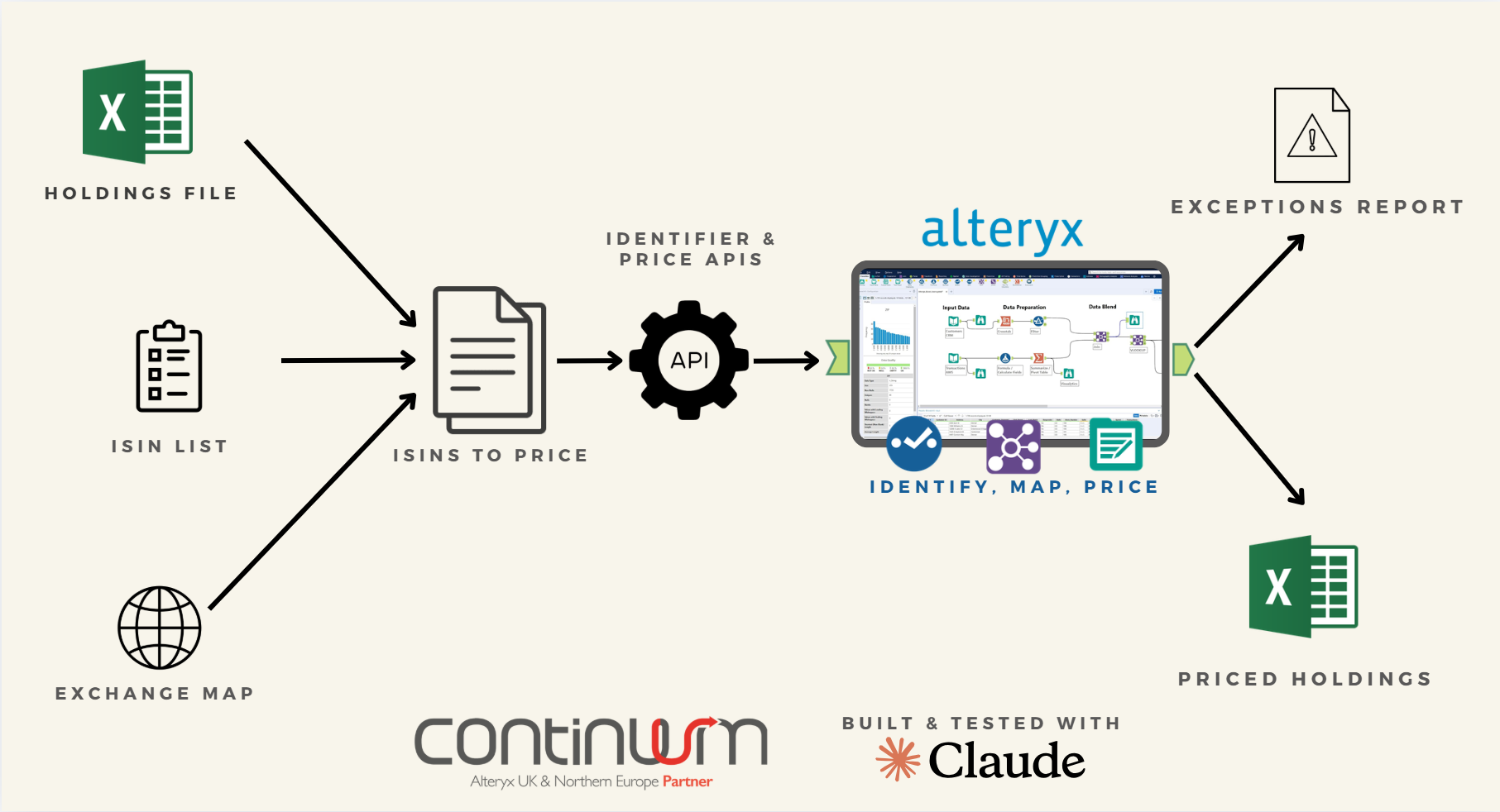
We designed a workflow that turns a list of ISINs into a priced holdings table in a single run. Each stage feeds the next automatically, and anything that can’t be resolved is flagged rather than guessed.
1. ISIN Input
Paste in a list of ISINs, or point the workflow at an existing holdings file. Nothing else needs preparing.
2. Security Identification
Each ISIN is sent to an identifier-mapping service, which returns every listing for that security: ticker, exchange, name, and security type. The workflow keeps all of them, rather than taking the first.
3. Market Mapping
The mapping service and the price source describe exchanges differently. A translation table converts one to the other, so each listing is matched to the right market before it’s priced. Listings on unmapped exchanges are routed to their own exceptions output.
4. Live Quote Retrieval
The workflow requests the latest quote for each mapped listing and returns a clean, typed table: ISIN, name, exchange, price, change, volume, and trading date. Failed or empty quotes go to a separate output for review.
How Claude Built It
We didn’t start with a spec. We started with a question: can we pull share prices into Alteryx? The workflow was built almost entirely by Claude, Anthropic’s AI assistant, with our team directing it.
Claude’s first contribution was pushing back. The data source we’d originally suggested turned out not to provide pricing at all, and it said so before building anything. From there it worked in stages: a simple ticker-pricing workflow first, then an ISIN lookup, then the two merged into one end-to-end process.
Two things made that possible:
It writes real Alteryx files. We’ve created a set of Alteryx skills for Claude covering the workflow file format, tool configuration, and common pitfalls. The output is a .yxmd file that opens straight in Designer.
It runs what it builds. Claude is connected to our Alteryx environment, so it can execute workflows and read the results rather than reviewing its own logic by eye.
That second point caught a real bug. A line-break character looked correct in a formula but wasn’t being interpreted as one, so extra listings were disappearing without any error message. Claude found it on the first test run, fixed it in one line, and patched every file. By eye, it would have been very hard to spot. In production, it would have produced incorrect numbers.
The Results
For this post, we ran the finished workflow on our Alteryx Server with three well-known ISINs: Barclays, HSBC, and Apple.
All three ISINs resolved first time.
Those three ISINs came back as 235 separate listings across exchanges worldwide.
15 listings were on mapped markets and went straight through to pricing, and we confirmed the pricing stage end to end with a live quote stamped with the latest trading day.
The other 220 were routed to exceptions for review, rather than being guessed at or dropped.
That 235 is the whole argument for automating this properly, because nobody doing this by hand is checking 235 listings. They’re picking one and hoping.
Just as telling is how quickly it came together. A workflow that might have taken a couple of days to design, build, and debug was done in a single working session.
What This Means for Your Team
The pattern of identify, map, fetch, and flag exceptions works whatever sits at the end of it. Most firms will want to plug in the market data they already license, and only the final stage changes. With this, the data sources at either end are interchangeable.
The bigger shift is how work like this gets built. Claude handled the research, the Alteryx build, and the testing. Our team handled the sense-checking: what the output needed to look like, which trade-offs were acceptable, and when to push back.
AI doesn’t replace the need to know your data, but paired with someone who does, it really changes how quickly you get from a problem to a trustworthy solution.
Want to See It in Action?
If your team is still looking up prices by hand, or you’re curious what Claude could do for your own Alteryx work, we’d be happy to talk it through. Get in touch and we’ll show you what it could look like with your own data requirements