Who They Are
An established Jersey-based HR consultancy providing outsourced HR support to businesses across the Channel Islands, the UK and the wider Crown Dependencies. Their clients range from small start-ups to large international firms, and the service covers everything from day-to-day HR administration and employment contracts to restructuring, recruitment and interim HR leadership.
That breadth of work produces a large and sensitive document estate. Every client has its own folder holding HR toolkits, handbooks and policies, employee records, job descriptions and recruitment files, built up over many years by many hands. As a business that advises others on employment law and data protection, our client wanted its own house to be in exemplary order.
The Opportunity
Our client had updated its document retention policy. Rather than a single blanket rule, retention now varied by document type, with more than 30 categories each carrying its own retention period. Applying that by hand across every client folder was not realistic, and several challenges quickly surfaced:
Documents could only be identified by their names: with no reliable metadata, the type of each document, and therefore its retention period, had to be inferred from file and folder names.
Inconsistent naming and embedded dates: years of manual filing meant dates appeared in dozens of formats, and the same document type was named in many different ways.
Version sprawl: drafts, numbered versions and "FINAL" copies sat side by side, making it hard to tell which file was current and which could safely be archived.
Folder drift: some client folders were missing parts of the standard template structure, others had folders in the wrong place, and some contained subfolders but no files at all.
Highly sensitive data: HR files include special category personal data, so the approach had to keep data inside our client's own environment, under their control, with a defensible audit trail for every decision.
Scale beyond the original estimate: discovery revealed a far larger and more varied estate than first planned, which shaped how the project was phased and funded.
How We Helped
We began with a data protection impact review and a pilot, then built the solution in two iterations.
Version 1: proving the rules
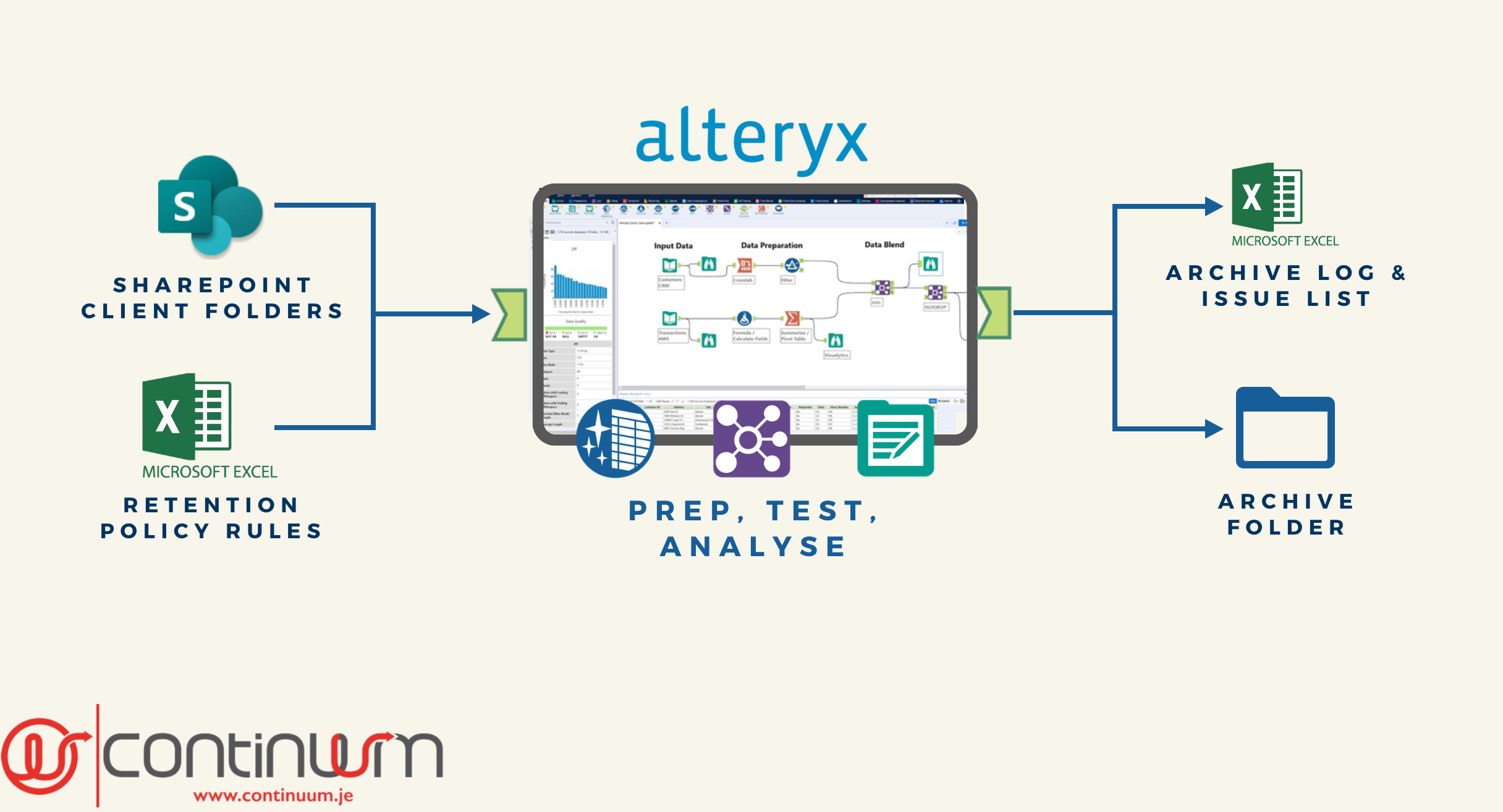
Secure by design: all processing ran inside our client's own Alteryx environment, with access controlled entirely by our client, so no files left their tenancy.
Discovery of the full estate: PowerShell and Alteryx were used to catalogue every client folder and file, including archived clients, producing a single inventory to work from.
A rules-driven retention engine: each file was matched to one of the 30+ document categories from a retention lookup table, with layered regular expressions cleaning names and extracting dates in their many formats.
Version and duplicate detection: older versions and duplicates were flagged automatically against the latest copy of each document.
Actionable outputs: a Master Archive Log, an Issue List for our client's team to review, and generated batch scripts to move approved files to the archive location.
Version 1 proved the rules worked, but it lived on a single canvas of more than 240 tools. Every change carried risk, hard-coded filters were difficult to maintain, and folder and file logic were tangled together.
Version 2: rebuilt with Claude
For the second iteration, we worked with Claude, Anthropic's AI assistant, alongside Alteryx to review the original design and restructure it into a modular, maintainable pipeline:
01 Data Prep: builds a clean inventory of clients, folders and files, including archived clients, and standardises paths and version labels.
02 File Tests and Retention Rules: applies each retention category and version test independently, so a rule can be changed without disturbing the rest.
03 Folder Tests: checks every client folder against the standard template structure and flags missing, misplaced and empty folders.
A new Analysis stage: confirms each active client has a current statement and handbook, catches documents filed at the wrong level, and maps stray policy, job description and general folders to their correct home in the template.
File moves in Python: approved files are now moved to the archive folder by a Python step inside Alteryx, with the outcome of every move written back to the log, replacing the batch scripts used in version 1.
The Impact
Defensible retention: every file carries a recorded category, retention period and reason for being kept, archived or queried, giving our client an audit trail they can stand behind.
Order restored across the estate: folder structures are checked against a single standard, with gaps and misfiled documents surfaced for action rather than discovered by chance.
Safer, faster change: splitting one large canvas into focused workflows means new rules or categories can be added and tested in isolation.
Human review where it matters: automation handles the volume, while anything uncertain goes to our client's team through the Issue List rather than being moved silently.
“We went into the project thinking about data cleansing and compliance. We came out thinking about business intelligence and growth.
Continuum helped us create cleaner, better-structured data, but the real value has been realising what we can now do with it: better CRM insight, stronger business development opportunities and smarter use of our information.
Clean data isn’t the destination. It’s the foundation for what comes next.” - Becky, HR Now
What's Next?
Moving retention rules from a spreadsheet into a version-controlled store, so every policy change is tracked.
Exploring content-aware document classification for ambiguous files, keeping the most sensitive categories local and redacting personal data before any AI step.
If your document estate has grown faster than your ability to govern it, get in touch to see how Continuum can help.